

Do you suffer from migraines, tender breasts, depression (especially before you get your menstrual bleed), fibroids, endometriosis, painful and/or heavy periods and clotting?
You may have what’s called oestrogen dominance.
This is when a female has too much oestrogen relative to her progesterone. In folks who don’t ovulate or ovulate infrequently, they don’t produce the healthy levels of progesterone that result from ovulation. This is a common problem associated with this highly prevalent syndrome.

What can you do to combat PCOS oestrogen dominance?
1) Phytoestrogens
This is where the phytoestrogen debate comes into play. Phytoestrogens can be found in foods like soy. Some people believe passionately that we should not include these phytoestrogens (as they are a form of oestrogen). In contrast, others believe we should (because they are a weaker form of oestrogen and can block the oestrogen receptor site, reducing the more profound effect of the stronger form of oestrogen).
The research, in my opinion, is not clear here.
Soy is added to many foods and products, and we will, no doubt, already be consuming more than we realise.
However, if we stick to a natural food plan and add less processed forms of soy in moderation, it may well be beneficial. This study by Patisaul and Jefferson talks about the potential pros and cons.

2) Avoid gut-upsetting irritants
It helps to avoid foods that upset our gut, as some of the “bad” gut bugs release an enzyme called beta-glucuronidase. This enzyme breaks down the bound-up oestrogen on its way to excretion. Combine this with a leaky gut (which is also common in PCOS) and you can resorb the now free oestrogen right back into your system again.
This is one reason I recommend that people avoid gluten, A1 dairy, and at least reduce their consumption of alcohol, cigarettes, and sugar.

3) Boost your intake of indole-3-carbinol
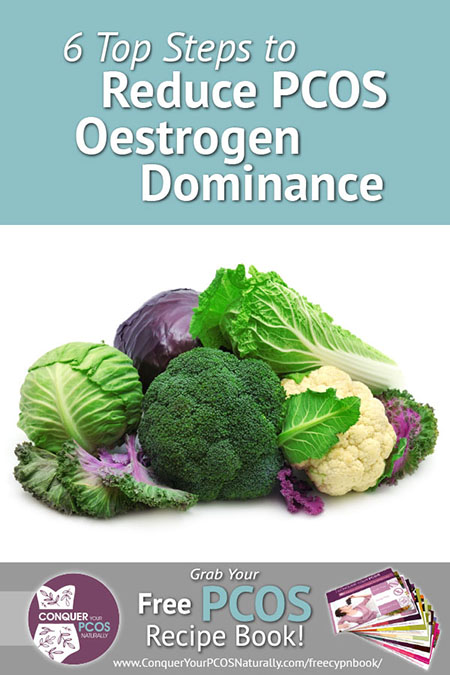
This nutrient has been proven to help detoxify your body of excessive oestrogen. Include reasonable amounts of cauliflower, broccoli, cabbage, watercress, and bok choy.

4) Enjoy healthy proteins
Fresh fish and free-range eggs are also excellent for promoting safe and healthy detoxification.
5) Choose anti-inflammatory foods
Potent anti-inflammatory foods are also essential for proper detoxification. Foods like beans, berries, artichokes, apples, and pecans are particularly beneficial here, and a high-quality supplement may support you, too.
6) Lose weight, if needed
This is particularly important, as we can convert the high testosterone levels of PCOS to oestrogen through a process called extra-glandular aromatisation in our fat cells.

With the proper knowledge, it’s possible to reduce, even eliminate, oestrogen dominance. And the benefits to the body are excellent! If you’d like to learn more about the condition, our article, Oestrogen Dominance and PCOS: What It Is & What To Do About It, provides valuable insight and practical tips.

From PCOS to perfect health, with love,

Dr. Rebecca Harwin
The PCOS Expert
Chiropractor & Bestselling Author of
Conquer Your PCOS Naturally
www.ConquerYourPCOSNaturally.com
P.S. PCOS affects so many, and it can interfere with a good quality of life. Please share this with your social media and share the link with your family and friends. Many people suffer from this condition in silence, and it is often not understood, let alone acknowledged, in mainstream medicine. Yet, there is hope, and there is help.
Love to pin? Share the love…
I just like the valuable information you supply to your articles. I will bookmark your weblog and take a look at again right here frequently. I’m moderately sure I’ll be informed lots of new stuff right right here! Best of luck for the following!
Dear Rebecca.
I am a chiropractic student in the UK! I developed migraines in 2011, I suffer with low mood and am currently being investigated for PCOS. I have been on contraceptives for years and was on the Mirena coil until i had it removed about a month ago. I was suffering with the most severe PMS I had ever experienced while on the Mirena. In fact i could literally plot my depression with my cycle and I felt suicidal the days before my period. My psychiatrist put me on Florentine which only made my mood much worse and i have now come off the Florentine and feeling the benefit. This is the first month without the coil and my PMS has been reduced dramatically!!.. This made me ask questions .. did the mirina coil contribute towards my PMS and depression? On researching the Mirina Coil it contains Levonorgestrel (progestin) a synthetic form of progesterone which is secreted locally into the womb. This can have a knock on effect and reduces (or stops) the amount of natural progesterone secreted by the follicles and adrenal glands. I am confused by how much the mirina coil effects estrogen production? It either doesn’t have an effect or has a small effect but either way the result is Estrogen dominance. If i also have PCOS which causes estrogen dominance has mirina coils have only amplified the effects by reducing natural progesterone further?
What i am also confused about is the link between estrogen dominance and depression and migraine. Reduced serotonin levels are a cause for both depression and migraine. An increase in estrogen it thought to increase serotonin levels. In someone that is estrogen dominant there is no reduction in estrogen therefor this should not effect serotonin levels. What is the link/ mechanism for which estrogen dominance causes depression and migraine and is it link to serotonin levels? if so how??
Many thanks
Hi Maia,
It’s lovely to meet you 🙂 What year are you in now?
The first thing I thought when reading through your PMS/depression was certainly a significant drop in progesterone, so I’m glad you are aware of this and the potential role it plays. You are right, it can be confusing! One would think local synthetic progesterone should help. But it’s not uncommon for women with the mirena to report this, and I also experienced it myself.
Women with PCOS have been shown to be magnesium deficient, and this can also contribute to migraines and depression as you’ll know. Maybe this is the link?
Have you read my book, Conquer Your PCOS Naturally yet?
Perhaps its not the levels of estrogen that is the issue? Perhaps it is the low levels of natural progesterone as a result of the coil and PCOS?
When there is an excess of glutamate, an excitatory neurotransmitter, this causes neurons to fire too frequently. The GABA-A receptor regulates excitement in the brain.
Progesterone is a metabolized to Allopregnanolone (a potent anxiolyte) that binds to the Gaba-A receptor in the brain in the amygdala.
When Allopregnanolone (from progesterone) binds to the Gaba-A receptor it essentially reduces ‘excitement’ in the brain and suppress the excitatory glutamate response.
Therefor if there is a deficit of progesterone there is increase in ‘excitement’ in the brain as ‘excitement’ is not moderated.
I have always been a super sensitive individual. I have a condition called Irlen Syndrome (also referred to at times as Meares-Irlen Syndrome, Scotopic Sensitivity Syndrome, and Visual Stress) is a perceptual processing disorder. It means that my brain is over active processing information. It does not only effect my visual processing but my other senses.. all my senses are super sensitive and have been my entire life. However something happened in 2011 that caused me to develop migraine.. this pushed my sensitivity off the scale. Any chemical smells and bright lights can trigger a migraine. I was under a lot of stress at the time which would of effected my cortisol levels and therefor my levels of progesterone produced by the adrenals. I was also using the Implanon (etonogestrel an synthetic version of progesterone) and believe this is when i began to be effected by PCOS. Following the develop of migraine i began to develop facial hair and changes in my mood (which i had attributed to the migraines). I always had a feeling that the extreme hypersensitivity which began in 2011 (beyond the Irlen syndrome) was somehow linked with my hormones.
Could I be along the right lines here??
Absolutely. Low progesterone is a key player. As is higher sensitivity to oestrogen like we see in fibroids and endometriosis as well.
I haven’t heard of Meares-Irlen Syndrome, will look it up.
“I was under a lot of stress at the time which would of effected my cortisol levels and therefore my levels of progesterone produced by the adrenals.” – Stress is a big player in PCOS; this article with help – https://www.conqueryourpcosnaturally.com/_blog/Blog/post/pcos-stress/ As our stress levels increase so, too, does inflammation and insulin resistance, potentially reducing FSH and ovulation. And without ovulation, we don’t produce the corpus luteum and our main source of progesterone production falters.
Migraines are linked to oestrogen dominance, as well as magnesium deficiency.
So, yes, I think you are on the right track.
Hi Rebecca,
Sorry i only just saw your reply and thankyou for being so prompt!!. Im in second year! I should be much further along but the impact of migraines and my mood has impacted my health severely and has caused several interruptions in my studies.
No i haven’t read your book yet as i only just came across your page today, and it was literally this weekend that i connected the dots between migraine and the removal of my coil and hormone levels. I had day 1 of my menstrual cycle (when progesterone and estrogen are lowest) this weekend and had a migraine. This has spurred my research into the connection and I found your page. I would love to read your book but i will have to get my exams in November and December out the way first (i should be studying now) hopefully i can put this down as pathophysiology research 😉
I need to get my sensitivity at a manageable level so i can be more functional. Practicing from home once i qualify will not be an issue as i can control my environment however attending college is an issue as the lights in the building are horrendous and some individuals continue to insist on wearing perfume to class (which has resulted in issues and is now being dealt with by the principle). I didn’t have to “cause such a fuss over their perfume” and my hypersensitivity and migraines was managed it would improve my quality of life all round. If management of hormones could be an answer then at least im heading in the right direction.
Thanks again for your help
I have recently started taking magnesium supplement so hopefully that should help once in my system. Feel free to email me to my email address if that is easier! Thankyou
Hi Maia,
I just wanted to check… How did you go with magnesium supplementation?
As you said synthetic progesterone should improve help.
Is progestin and etonogestrel converted to allopregnanolone in the same way?
Could I be deficient in allopregnanolone and is there a way of increasing it naturally? I will order a copy of your book now.